


10 minutes ago6 min read


Sep 221 min read


Aug 188 min read

The mid-terms are finally done.
In a firm rebuke to Trump, democrats had a tremendous and statistically unlikely showing.
What impact might the blue wave have on markets?
First of all, markets like that the election is over.
Historical performance of the S&P 500 one year after the midterm elections are strong. More on that below.
Second, a divided government is preferred by the market over a one-party government.
Third, this election was not about policy. It was a referendum on Trump, and more broadly on the never-ending wars that cause inflation, death and distraction from what is important.
From the standpoint of wanting to end wars, the election results were great.
But from a market standpoint, risks to the one bright spot in the market, AI and its buildout, took a big step backwards.
Let's look at the pros and cons.
Positives:
The election is done. The election itself is an uncertainty, and the fact that it is over means that an uncertainty is removed.
Returns following mid-terms have historically been very good.
Markets tend to prefer a split government
Negatives:
AI and data center manufacturing projects failed on 41 of 41 ballots. This is a big negative for markets, and it is being felt today with markets down over 4%.
Fraud exposure at scale is unlikely to happen.
The 2026 midterms were extremely light on policy talk. So analyzing the potential impact on markets of sweeping legislative reforms is not necessary.
So let's start with the basics.
Generally speaking, markets move on a combination of components and catalysts.
Components refers to the day-to-day workings of the global economy. These components, such as earnings, costs, interest rates, inflation, and currency fluctuations, power the economy and financial markets on a daily basis.
Catalysts are the one-off events such as COVID, the financial crisis, war, etc.
The condition of the components drive overall market trends. Catalysts can change the trajectory of those trends.
Right now, the components aren't bad, but they aren't great either:
Inflation is high;
Interest rates are high;
Growth is slow, but positive;
Employment is okay.
Earnings have been led by tech and AI
With conditions somewhat "blah", markets are looking for a positive catalyst to improve the current condition of the components.
Without a positive catalyst, markets are stuck in a "Status Quo" mode.
Status quo is high inflation, high interest rates, and slow growth.
The irony of this election is that the results likely solidified the status quo.
The blue wave wants inflation to go down, but they just voted for inflation to stay high.
Those who voted for interest rates to go down actually voted to keep interest rates high.
Why?
In our view, two catalysts could potentially increase the growth rate or reduce costs in major ways across the economy:
Artificial Intelligence adding manufacturing activity through the buildout of data centers, productivity increases and cost reduction;
Reduction of institutionalized fraud in government, resulting in lower taxes, lower interest rates and increased efficiency.
Without these two major catalysts, markets will need something else to push markets out of status quo mode.
Status quo is not always bad.
But right now it's been 18 years since the last recession.
Stocks have been in a major bull market for approaching 20 years.
Interest rates have flipped from falling to rising.
This is the kind of late-cycle environment that is prone to trouble.
In a status quo market, we expect stocks to be flat for a long period of time, potentially 10 years or more. This has happened the last two major cycles where inflation and interest rates were rising.
This type of investing environment isn't terrible, it's just different
Buy-and-hold strategies don't work in the type of environment we could be entering. You don't want to own an index and not look at it.
Higher interest rates can be a positive for portfolios by extending duration and reducing risk compared to stocks, so part of the opportunity is to de-risk as interest rates rise.
More on this scenario in the coming weeks.
Let's focus on the election aftermath.
As with most elections, the fact that they are simply over removes uncertainty from the markets.
For the 12 months following midterm elections, historical performance of the S&P 500 has been excellent.
Our first chart from Investingvisual.io shows that markets tend to do well after midterms, regardless of the macro environment or political current at the time.
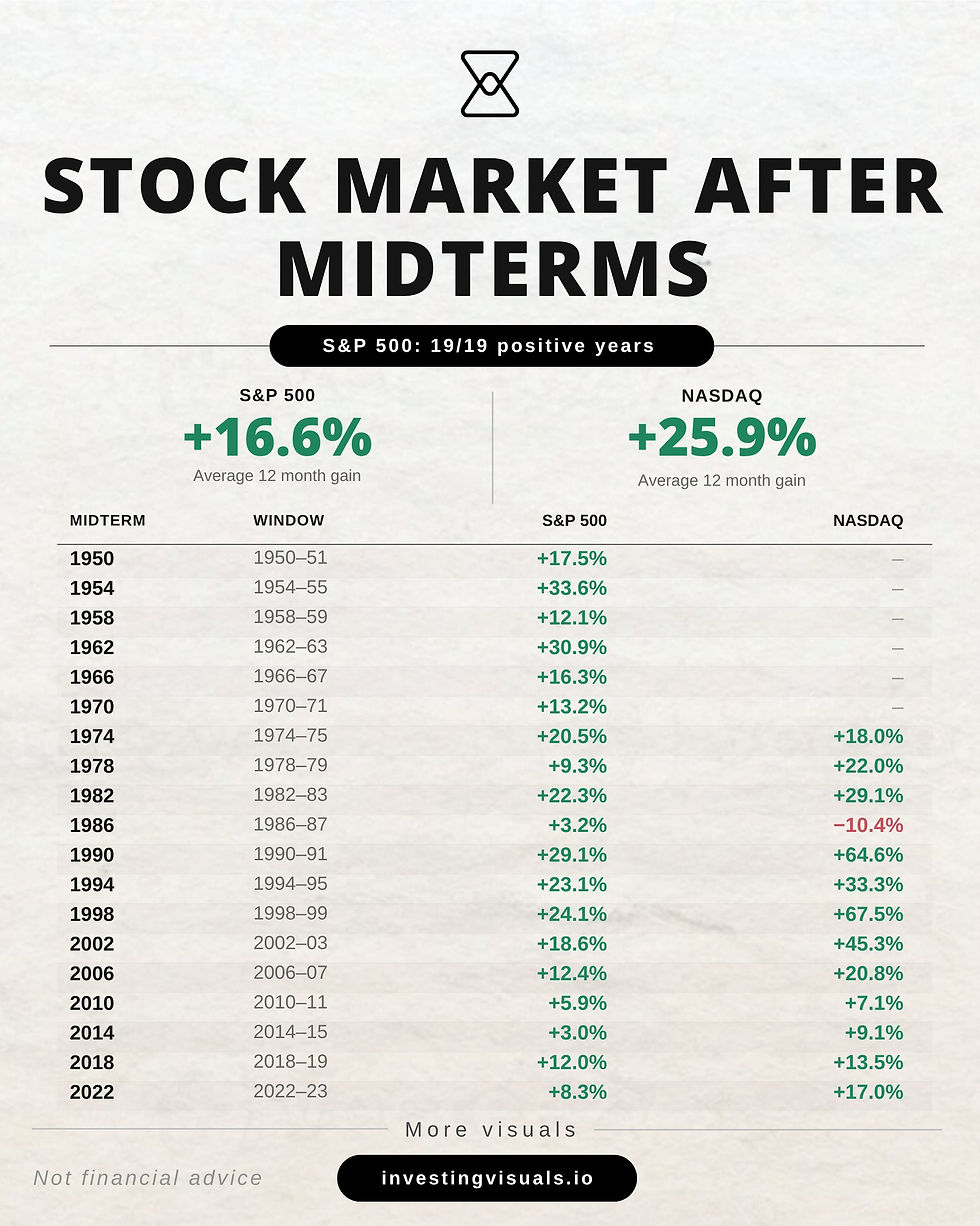
The average 12-month performance after midterm elections is 16.6% for the S&P 500, and a whopping 25.9% for the Nasdaq.
And the S&P 500 has been positive a year later EVERY SINGLE MIDTERM of the last 19.
That's pretty good.
And it tells us that the midterm election itself is a risk. And when the electoin is over, the risk is gone.
It is not about which side wins or loses. The election itself is both the cause of the risk and the resolution of the risk.
Markets tend to pause before a national election as investors wait for the election to happen. Once it does, markets tend to play catch-up.
So we are packing in 14 or 15 months of historical market moves into 12 months once the election is over. Markets have an upside bias, so adding time to a statistical interval improves its data.
This pause has happened this year as well.
Should we expect similar returns this time?
Maybe.
Higher returns 19 out of the last 19 times is impressive, so we have to consider this as a bullish data point.
Does it matter which side is in power?
Looking at stock performance by president, there is really no difference when it comes to republicans or democrats being in power.
The worst performer was George W. Bush, who had both the tech bubble and 2008 financial crisis happen on his watch.
So any discussion on whether a republican or a democrat is better for stocks isn't statistically important.
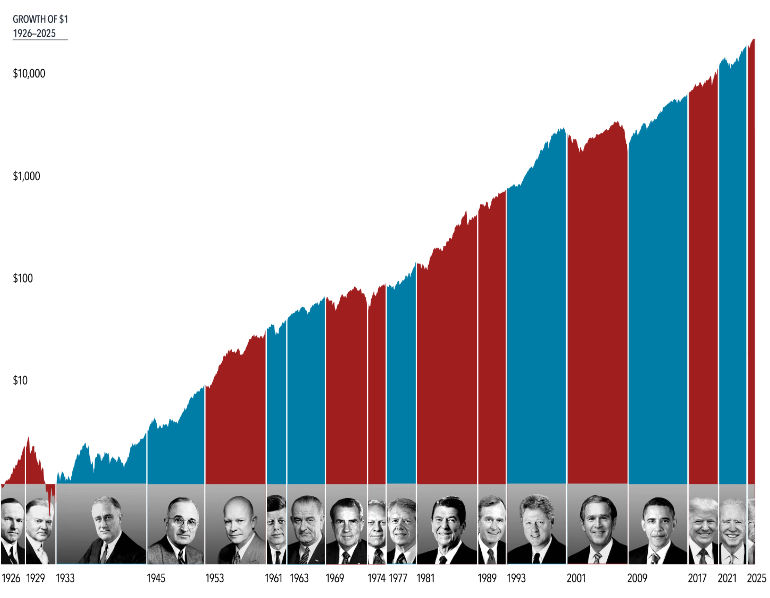
Volatility and returns are likely not due to one party or another.
The primary area that may be a positive catalyst to markets is the AI buildout.
One of the biggest outcomes of the blue wave is that it most likely drowned that AI trade.
Voters were asked to approve data centers on 41 ballots across the country yesterday. They failed on all 41 ballots.
The biggest potential positive catalyst was just intentionally removed by the electorate.
How many companies are going to embark on a massive spending project when voters just turned them down?
Tech is selling off hard on the results, and that could easily continue.
And tech is a huge part of markets, so tech weakness will absolutely lead to market weakness.
We are seeing that today with markets down over 4%.
This is a direct result of the election.
Another one of the potential positive catalysts that still may turn out to happen is a reduction of governmental fraud.
While there is quite a bit of positive developments happening in the exposure of corruption, that process also took a big step back this week.
In California last month, they passed a law to arrest and punish individuals who find and report fraud, dubbed the "Nick Shirley Act", based on the independent journalist who has uncovered billions of dollars in fraud in Minnesota and California.
Passing a law against finding and exposing fraud shows you who is committing it.
It also tells you that it is in fact happening, and they don't want you to know about it.
The people banning fraud investigations just won big nationwide, so we can probably say goodbye to the potential of finding and eliminating fraud, without major developments occurring.
In Austin, voters decided to not make the city audit their finances.
This is insane, and I don't care if you're offended.
None of this makes any sense whatsoever.
It is tribal politics at its finest.
We are by far worse off as a society by not holding politicians accountable for how they use our tax money.
The status quo won.
The irony of the midterms is that voters wanting change likely locked in the status quo that they wanted to vote out.
Markets are likely to be flat over a long period of time, with increased volatility as the late cycle environment keeps returns in stocks limited.
We will do a webinar to answer questions next week, so watch for that announcement.
Stay nimble. Markets are likely to be choppy and volatile as the next steps of the AI buildout occur.
Invest wisely!